
Schedule A TRO Defense: Why Court Appearing Matters
A recent Federal Circuit decision shows how actively defending a Schedule A TRO can force plaintiffs to support infringement and irreparable harm allegations with defendant-specific evidence.
A recent Federal Circuit decision shows how actively defending a Schedule A TRO can force plaintiffs to support infringement and irreparable harm allegations with defendant-specific evidence.

The EU General Court has upheld the refusal of OpenAI’s attempt to register “OPENAI” as an EU trademark for certain AI-related goods and services. The decision highlights an increasingly important issue for technology companies: when a brand name directly describes the technology or services being offered, commercial recognition alone may not guarantee trademark protection.

7-Eleven v. Nike shows how a sneaker colorway can trigger color trademark, trade dress, dilution, and cross-category confusion claims.

How far can a public official’s personal name become a private commercial brand?
From DJT Airport to Trump 250 trademark filings.

A recent trademark dispute shows how traditional motifs, famous marks, and rapid brand expansion can collide in modern consumer branding.
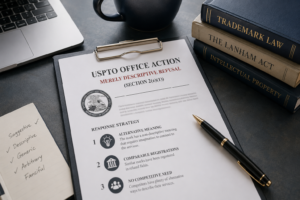
A merely descriptive refusal does not always mean a trademark application is lost. Learn how a focused Section 2(e)(1) response can show suggestiveness and overcome USPTO objections.

Section 15 incontestability can strengthen a U.S. trademark after years of continuous use. Learn when it may be available and what it does not protect.

USPTO scrutiny of mass trademark filings can affect sellers directly. Learn how risky agencies, weak filings, and improper signatures create trademark risk.

A trademark attorney does more than submit forms. Learn how clearance search, filing strategy, specimens, and USPTO responses affect brand protection.

Foreign applicants must use a U.S. trademark attorney before the USPTO. Learn why attorney review matters beyond basic filing requirements.