Category: Trademark / Trade Dress / Brand Enforcement / Fashion & Retail
Reading Time: 5 minutes
Overview
A sneaker colorway may look like a design choice, but it can become a trademark dispute when it closely resembles a famous brand’s visual identity.
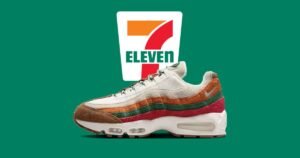
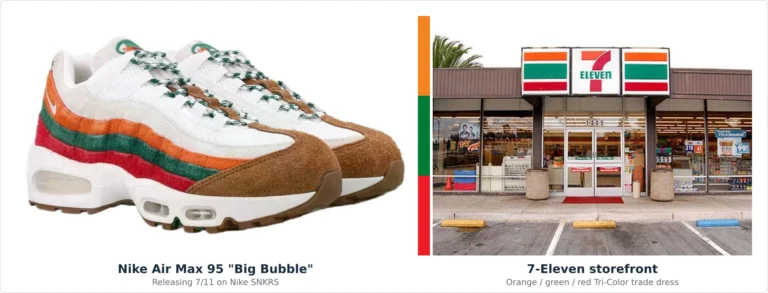
In 7-Eleven, Inc. v. Nike, Inc., filed in the Northern District of Texas on July 1, 2026, 7-Eleven alleges that Nike’s Air Max 95 colorway improperly uses its orange, green, and red brand colors in a way that creates confusion, false association, and dilution.
Key Takeaways
1. Color can function as a trademark, but only with strong proof of secondary meaning.
2. Product design and color combinations generally do not receive automatic trademark protection.
3. Cross-category claims may be stronger when prior collaborations make brand association plausible.
4. Dilution claims can sometimes avoid the strict limits of direct product competition.
The Dispute
7-Eleven sued Nike over an Air Max 95 colorway featuring orange, green, and red stripes. The timing made the dispute more sensitive: the launch was allegedly planned for July 11, known as “7-Eleven Day.” 7-Eleven claims the shoe design, marketing context, and related details evoke its brand identity.
The complaint asserts claims under the Lanham Act, including trademark infringement, unfair competition, and dilution, along with Texas state-law claims. 7-Eleven seeks permanent injunctive relief, recall and destruction of the accused products, disgorgement of profits, treble damages, punitive damages, attorneys’ fees, and costs.
Can Colors Be Trademarked?
Yes, but the threshold is high.
U.S. trademark law does not treat color as inherently distinctive. A color, or color combination, must acquire secondary meaning: consumers must associate the color scheme with a particular commercial source.That principle is especially important here. Orange, green, and red are ordinary colors. 7-Eleven’s argument depends on whether decades of consistent use have made that specific combination source-identifying. 7-Eleven appears to rely not only on long-term use, but also on federal registrations that may strengthen its position.
Trade Dress and Product Design
Trade dress protects the overall look and feel of a product, store, packaging, or commercial presentation. The key limits are non-functionality and distinctiveness.
For product design, however, the law is stricter. Under Wal-Mart Stores, Inc. v. Samara Brothers, product design cannot be inherently distinctive; it must acquire secondary meaning. Color marks face the same challenge. This means 7-Eleven must show that the relevant public recognizes the color combination not merely as attractive design, but as a brand identifier.
The classification matters. If the colors are treated as part of 7-Eleven’s store identity, the evidence may look different from a case about sneaker product design. Nike, by contrast, may argue that the colors are aesthetic, expressive, or part of sneaker culture’s long tradition of “inspired” colorways.
Why Cross-Category Confusion Is Plausible
Convenience stores and sneakers are not obvious competitors. But 7-Eleven has several arguments.
First, it may claim that its color marks are famous enough to support dilution. Dilution does not require direct competition or ordinary consumer confusion; it focuses on whether use weakens the distinctiveness of a famous mark.
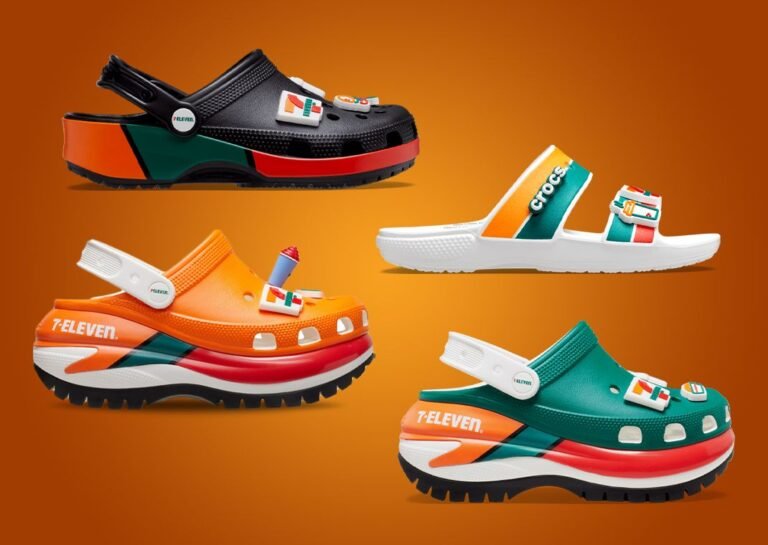
Second, 7-Eleven has previously collaborated with Crocs on footwear and reportedly had a past unrealized collaboration with Nike. That history may make consumers more likely to believe the Air Max 95 is an official collaboration rather than a coincidence.
Third, alleged design and marketing details may matter. If product storytelling, packaging, or interior graphics evoke convenience-store culture, 7-Eleven can argue that Nike intended to create a commercial association.
Possible Nike Defenses
Nike has not yet fully litigated the merits, but several defenses are likely. It may argue that the colorway is aesthetic rather than source-identifying, that 7-Eleven’s color combination lacks secondary meaning in the sneaker market, or that consumers familiar with sneaker culture understand the design as homage rather than official collaboration.
Nike may also challenge likelihood of confusion, dilution, and the scope of 7-Eleven’s registrations. Procedural defenses may also arise depending on timing, product availability, and actual commercial use.
Practical Takeaway
7-Eleven v. Nike shows that color is not legally “free” merely because it is visual or decorative. When a color combination is strongly associated with a brand, use in another industry may still create risk, especially where collaborations are common.
For brands, the lesson is clear: before launching a colorway, capsule collection, or cultural tribute, clearance should cover not only names and logos, but also color systems, trade dress, prior collaborations, and the likelihood that consumers will perceive the design as an official partnership.
Disclaimer
This article is for general informational purposes only and does not constitute legal advice. Reading this article does not create an attorney-client relationship. Businesses should consult a licensed before legal or commercial decisions.
Contributors

Jane (Jie) Li
Founding Attorney
California | +1. 213. 774. 2132
jli@innoslaw.com

Kefei Wu
Director of Global Operations
Paris | +33. 6. 98. 12. 89. 80
kwu@innoslaw.com